Valsalva vs Frenzel — Which Equalising Method Should Spearos Use?
Compare Valsalva and Frenzel equalisation for spearfishing — depth limits, safety, and when to switch techniques.
Every spearo equalises ears on descent. The method you choose determines how deep you can go safely and comfortably. For breath-hold diving, Frenzel wins — but understanding Valsalva explains why so many beginners hit a wall at 10 metres. This comparison is written for Victorian spearos working in 3–15 metres of temperate reef water, not for competitive deep freedivers.
If you are currently stuck at depth, read Can't equalise past 10 metres? for troubleshooting, then Frenzel for spearos for the fix.
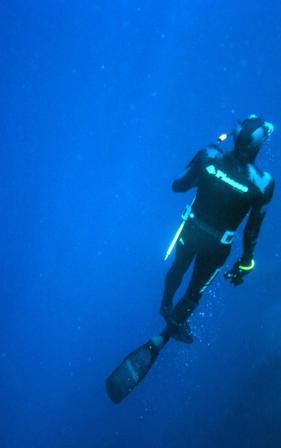
Photo: David McMurdie, CC BY-SA 3.0, via Wikimedia Commons
Why equalisation method matters for spearfishing
Equalising is not a minor technical detail. It determines whether you can reach the depth where fish hold, whether you cause cumulative ear damage, and how much oxygen you waste straining on every descent. Bad technique ends dive days early, limits your hunting options, and sends spearos to ENT specialists.
Scuba divers breathe compressed air and equalise against full lungs throughout descent. Spearos hold one breath and descend on a finite air reserve that shrinks with depth. The physics favour Frenzel. The learning curve favours Valsalva — until it does not.
Valsalva manoeuvre
How: Pinch nose, blow gently against closed nostrils using diaphragm/chest pressure.
Pros: Intuitive; works on first pool session; fine for snorkelling in 1–3 m; no learning curve for shallow use.
Cons: Relies on lung volume. As lungs compress with depth, available pressure drops. Most divers cannot Valsalva reliably below 10–15 m. Uses more oxygen and fights relaxation — both problems for breath-hold diving.
Best for: Scuba diving with full lungs; very shallow spearfishing; surface snorkelling.
Valsalva is the first method most people discover naturally. Pinch nose, blow, ears pop. That works in a swimming pool at 2 metres. It often works on a spearfishing duck dive to 5 metres. Then it stops — and the diver assumes they have "bad ears" rather than the wrong technique.
Frenzel manoeuvre
How: Pinch nose, close glottis, use tongue as piston to push air into middle ears — no chest involvement.
Pros: Works at depth where lungs are compressed; more controlled; less oxygen cost; industry standard for freediving and spearfishing; reduces barotrauma risk compared to forced Valsalva.
Cons: Takes practice — often days or weeks to learn on land before reliable water transfer.
Best for: All spearos planning to dive beyond shallow reef.
Full tutorial: Frenzel for spearos.
Frenzel is taught in every credible freediving course — AIDA, PADI Freediver, Molchanovs. Victorian spearfishing clubs and schools run equalising workshops because the sport depends on divers getting past the Valsalva ceiling without injuring their ears.
Quick comparison
| Valsalva | Frenzel | |
|---|---|---|
| Depth ceiling (typical) | ~5–15 m | 30 m+ with training |
| Uses chest pressure | Yes | No |
| Oxygen cost | Higher | Lower |
| Learning curve | Easy | Moderate |
| Recommended for spearfishing | Shallow only | Yes |
The depth ceiling for Frenzel is not the limiting factor for Victorian shore spearfishing. You will hit fish depth long before you hit Frenzel's limits. The comparison matters because Valsalva's ceiling is exactly where Victorian reef fishing happens.
When to switch
Switch to Frenzel when:
- Ears hurt below 8–10 m despite "trying harder"
- You run out of equalisation before reaching fish depth
- You feel exhausted from straining on every dive
- You hear crackling or have muffled hearing after dive sessions
Read: Can't equalise past 10 metres?
Do not switch by forcing harder Valsalva. That causes barotrauma. Switch by learning Frenzel on land, then transferring to shallow water with a buddy.
Can you use both?
Many divers Valsalva the first metre or two — where lung volume is still high — then switch to Frenzel deeper. This hybrid approach is common and acceptable. The goal is reliable ears without force at any depth.
Be honest about which method you are using. Valsalva that "still works" at 8 metres with visible straining is not working — it is surviving. Frenzel at 8 metres should feel soft and repeatable.
Other techniques (brief)
- Voluntary tubal opening (VTO) — some divers naturally pop ears without hands by moving jaw and throat muscles. Rare as a sole method; often develops after Frenzel mastery.
- Mouthfill — advanced; injects air from mouth at depth for dives beyond Frenzel's comfortable range. Not for beginners. Not needed for Victorian shore spearfishing.
- Toynbee manoeuvre — swallowing with pinched nose. Occasionally assists but not a primary spearfishing method.
Do not chase advanced techniques until Frenzel is automatic in 10 metres. Depth progression without blackout safety is a separate mistake — fix equalising and safety before adding depth.
Safety comparison
Both methods are safe when used correctly. Both are unsafe when forced through pain.
Valsalva encourages force — blowing harder when ears do not clear. That force against a closed tube causes barotrauma. Frenzel is gentler by design — repeated soft tongue pistons rather than one diaphragm push.
Diving congested is unsafe with either method. Cancel dive days when sinuses are blocked. See can't equalise guide for congestion detail.
Victorian spearfishing context
Most Victorian target species — snapper, flathead, trevally, squid, reef species — are accessible within 12 metres on shore dives. You do not need competition-level equalising. You need Frenzel reliable to 10–15 metres with calm, repeatable technique.
Read How to spearfish snapper in Victoria for species-specific depth context. Read beginner gear guide for mask fit — mask issues mimic equalisation problems.
Regulations do not specify equalising method. The VFA specifies where and what you can take. Your ears specify how you get there safely.
Learning path
- Read this comparison
- Practise Frenzel dry for one to two weeks — Frenzel guide
- Pool and shallow bay sessions with buddy
- Reef diving at 5–8 m cap until automatic
- Progress depth alongside weight belt and aspetto training
Do not skip steps. The Victoria beginner guide places equalising before speargun hunting for good reason.
FAQ
I equalise fine with Valsalva in 6 m — do I still need Frenzel?
If you never go deeper, maybe not yet — but Frenzel still reduces injury risk and fatigue. Most Victorian spearos eventually want 8–12 m access for snapper and reef species.
Can I use both?
Many divers Valsalva first metre then Frenzel deeper. Goal is reliable ears without force.
Does equalising matter for spearfishing if I stay shallow?
Yes — even 3–5 m needs frequent equalising; bad technique causes chronic ear issues over a season of diving.
Which method do scuba instructors teach?
Scuba courses teach Valsalva because it works with full lungs and continuous air. That does not make it the right method for spearfishing. Do not assume your Open Water training covered breath-hold equalising.
How long to learn Frenzel from Valsalva?
Days to weeks with daily dry practice. One coached session often accelerates dramatically. See Frenzel guide.
Is one method better for cold water?
Cold does not change the physics. Congestion from cold exposure can block tubes regardless of method. Victorian winter diving — thicker wetsuit, shorter sessions — still requires Frenzel if you are below 8 metres.
What if only one ear equalises?
Common during learning. Keep practising dry. Do not force the blocked side. See an instructor if asymmetry persists after weeks of practice.