Frenzel Equalising for Spearos — Step-by-Step Land Practice
Learn the Frenzel equalisation technique for spearfishing and freediving — dry drills, common mistakes, and a two-week practice plan.
Frenzel is the equalisation method serious spearos use. It pushes air into your middle ears using your tongue and throat — not your chest — so it still works when your lungs are compressed at depth. If Valsalva stops working past 10 metres, Frenzel is your path forward.
This guide walks through the technique step by step, dry training drills, a two-week practice plan, and common mistakes. Read Valsalva vs Frenzel first if you are unsure why your current method hits a ceiling. Pair water sessions with our buddy system — never practise duck dives alone.
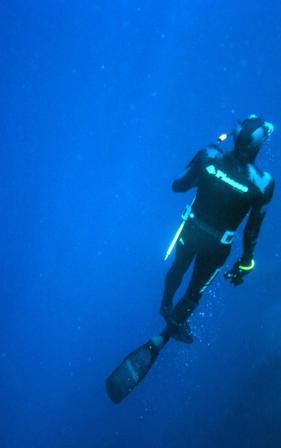
Photo: David McMurdie, CC BY-SA 3.0, via Wikimedia Commons
Why spearos need Frenzel
Scuba divers equalise with full lungs and continuous air supply. Spearos equalise on a breath hold while descending head-first or horizontally. Lung volume shrinks with depth. Valsalva — pushing air with your diaphragm — loses effectiveness as pressure increases.
Frenzel isolates the equalisation mechanism from lung volume. Your tongue acts as a piston, compressing air in the back of your throat and pushing it through the Eustachian tubes into the middle ear. The technique uses less oxygen than straining Valsalva and allows more relaxed descents.
Victorian shore spearfishing rarely requires extreme depth. Most fish are taken between 4 and 15 metres. Frenzel reliably covers that range with practice — and sets the foundation if you progress deeper later. Mouthfill and other advanced techniques are not needed for typical Victorian reef diving.
Frenzel in plain English
- Pinch your nose closed
- Close your glottis (the "hold your breath" throat lock — a small click at the back of your throat)
- Place the back of your tongue against the soft palate
- Move the tongue up and forward like saying "K" or "G" — compressing air into the nasal cavity and through the Eustachian tubes
You should feel ears click without straining your abs. If your stomach tightens, you are doing Valsalva, not Frenzel. Back up to dry practice.
Some instructors describe the tongue motion as a slow "K" repeated, or as scooping the tongue upward against the palate. Find the cue that produces a soft click in both ears.
Dry training steps
Step 1 — Glottis control
Inhale, close throat as if holding breath, try to exhale — no air should escape. That is glottis closed. Practise 20 repetitions until automatic.
This is the foundation. If air leaks past your glottis during Frenzel, air escapes through your mouth instead of routing to your ears. You will feel the leak as a faint exhale against your pinched nose.
Practise in front of a mirror initially. Place a hand on your stomach — it should stay relaxed. Chest and diaphragm do not participate in Frenzel.
Step 2 — Tongue piston without nose pinch
Say "K-K-K" with mouth closed, feeling tongue press upward against the soft palate. Add nose pinch once the motion is clear.
You may feel vibration in your ears without a full equalisation. That is progress — the tongue piston is moving air in the right direction.
Some divers use a balloon or Otovent device under instructor guidance to build pressure awareness. Not required for everyone, but useful if you cannot feel the tongue motion clearly.
Step 3 — Connected Frenzel
Nose pinched, glottis closed, tongue piston. Both ears should equalise softly. If only one clears, keep practising — asymmetry is common early.
Do not force. Gentle repeated "K" motions beat one aggressive push. If ears do not clear dry, they may still clear underwater where pressure assists — but dry success is the reliable indicator you have the mechanics right.
Step 4 — Transfer to water
Pool or shallow bay only. Equalise every metre. Stop if pain. Pair with buddy system.
Horizontal pool swims are ideal first water sessions — equalise every few strokes of a gentle breaststroke along the pool bottom. Then progress to vertical duck dives in 3–5 metres with a buddy watching.
Victorian bay water in summer works for shallow practice. Choose calm days, clear legal water, and a site with easy exit. See Port Phillip Bay beginner guide for site planning.
Two-week practice plan
| Day | Activity |
|---|---|
| 1–3 | 10 min dry Frenzel drills, twice daily |
| 4–5 | Pool snorkel — horizontal, equalise every 2 m max |
| 6–7 | Rest ears if sore; review Valsalva vs Frenzel |
| 8–10 | Shallow duck dives with buddy, 3–5 m cap |
| 11–14 | Add slow descent on reef — still shallow |
Do not skip rest days if ears are sore. Barotrauma from forcing practice sets you back weeks. Two weeks is a minimum — some divers need four to six weeks for reliable water transfer.
After two weeks, if Frenzel works in the pool but fails on the reef, the issue is usually descent speed, head angle, or stress — not the core technique. Slow down, neutral neck, calm breathing on the surface before descent.
Common mistakes
- Using chest pressure — that is Valsalva sneaking back in. Hand on stomach during practice catches this.
- Equalising once per dive — equalise continuously on descent. Every metre in the first 10.
- Looking straight down — neutral neck helps tube opening. See can't equalise guide.
- Practising when congested — wastes time and risks injury. Cancel and dry practice only.
- Skipping glottis control — without a sealed throat, Frenzel cannot work. Return to Step 1.
- Rushing water transfer — pool success does not mean reef success on day one. Cap depth until equalising is automatic.
Frenzel variations you may hear about
Frenzel-Fattah and other advanced variants refine the tongue motion for deeper diving. Recreational Victorian spearfishing does not require these. Master basic Frenzel first.
Hands-free equalising (VTO — voluntary tubal opening) is a separate skill some divers develop naturally. Do not chase it as a beginner. Reliable nose-pinch Frenzel comes first.
Mouthfill injects air from the mouth at depth for very deep diving. Not for shore spearfishing in Victoria. Not for beginners at any depth.
When to get coaching
If Frenzel has not clicked after two weeks of honest practice, one session with a freediving instructor saves months of frustration. Many Victorian clubs run equalising workshops. An instructor can watch your throat, identify whether you are Valsalva-ing, and give cues that land immediately.
AIDA and PADI freediving courses include equalising instruction as core curriculum. Even if you do not want certification, a single coached session is worth the cost.
Frenzel and the rest of your spearfishing progression
Equalising is one pillar. The others are blackout safety, buddy diving, and gear setup. Work on them in parallel but do not add depth or speargun hunting until Frenzel works reliably in 5 metres.
Once equalising is comfortable, read weight belt and buoyancy and begin aspetto technique in shallow reef.
FAQ
Is Frenzel safe?
Yes — it uses less force than aggressive Valsalva and is the standard in freediving education. Forcing any equalisation through pain is not safe.
Do I need mouthfill for spearfishing?
No. Mouthfill is an advanced depth technique. Victorian shore spearfishing rarely needs it.
Can I equalise hands-free?
Some advanced divers learn this. Beginners should nose-pinch reliably first.
How is Frenzel different from Valsalva?
Valsalva uses chest and diaphragm pressure. Frenzel uses tongue and throat. See full comparison in Valsalva vs Frenzel.
Can I practise Frenzel every day?
Dry practice daily is fine. Water practice should stop if ears are sore. Congestion days are dry practice only.
Related: Spearfishing Victoria beginner guide · Can't equalise past 10 metres