Why You Can't Equalise Past 10 Metres (And How to Fix It)
Can't equalise when spearfishing or freediving? Learn why Valsalva stops working at depth and the fixes that actually work for Australian spearos.
If you stall at 5–10 metres with painful or blocked ears, you are not "bad at diving" — you are almost certainly using the wrong equalisation method for breath-hold. This is the most common frustration new spearos report, and it has a fix. Victorian reef diving puts most target species between 4 and 15 metres. If you cannot equalise reliably through that range, you are leaving fish on the table and risking barotrauma every dive.
This article explains why equalisation fails, what to do in the water when it happens, and how to fix the problem permanently. For the solution, start Frenzel equalising for spearos. For context on why your current method hits a ceiling, read Valsalva vs Frenzel.
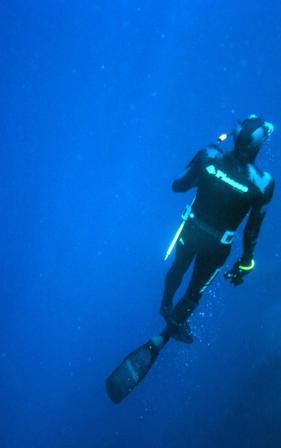
Photo: David McMurdie, CC BY-SA 3.0, via Wikimedia Commons
Why pressure hurts your ears
As you descend, water pressure pushes on your eardrum. Air in the middle ear must be replenished through the Eustachian tubes — small passages connecting your middle ear to the back of your throat. Fail to equalise and pain quickly becomes injury (barotrauma). Barotrauma can cause lasting hearing damage, ruptured eardrums, and weeks out of the water.
The first 10 metres are the worst — pressure doubles in the top 10 m compared to the surface. Boyle's law: at 10 metres you are at 2 atmospheres absolute pressure. At 20 metres, 3 atmospheres. The steepest increase is shallow, which is exactly where Victorian shore diving happens.
Your Eustachian tubes must open to let air into the middle ear. Some people's tubes open easily. Others need technique and practice. Almost nobody needs to force through pain — that is a technique or congestion problem, not a structural limitation.
Valsalva — why it fails spearos
Valsalva means pinching your nose and pushing with your chest/diaphragm to force air up. It works for scuba divers with full lungs and horizontal posture. It often works shallow on freedives — the first few metres feel fine.
Below ~10–15 m your lungs are compressed. There is less air volume to push. Valsalva simply runs out of pressure — exactly when you need equalising most. The diaphragm cannot generate enough force against compressed lung volume to push air through the Eustachian tubes.
Symptom: Equalising works for the first few metres then stops completely. You feel stuck at a depth ceiling despite being fit and calm.
Fix: Learn Frenzel. Read Frenzel equalising for spearos and Valsalva vs Frenzel. Frenzel uses the tongue and throat as a piston, independent of lung volume. It is the standard equalisation method in freediving and serious spearfishing worldwide.
Many Victorian spearos report hitting the 8–10 metre wall in their first season. The ones who push through with coaching reliably reach 15–20 metres within months. The ones who force Valsalva risk chronic ear problems.
Other common causes
Equalising too late
Equalise on the surface before descent. Equalise again during the duck dive. Then every metre — before pain. Some instructors say every half metre in the first 10 metres.
Pain means you are already behind. Ascend 1–2 m, clear, try again. Never push through sharp pain hoping it will "pop." That pop may be barotrauma.
Develop a rhythm: equalise, descend half a metre, equalise, descend. Slow controlled descents beat fast drops that outrun your ears.
Poor nose pinch
Leakage around the mask skirt or incomplete pinch wastes air. Some divers use a dedicated nose clip for training — not typically for spearfishing with a mask, but useful for dry Frenzel practice.
Ensure your mask skirt sits evenly on your face. Hair caught under the skirt causes leaks that make equalising harder. A low-volume freediving mask helps — less air to manage, easier to clear.
Congestion
Colds, allergies, and sinus inflammation block Eustachian tubes. Do not dive congested — you risk reverse squeeze and barotrauma on ascent. One blocked tube can equalise on descent and fail on ascent as pressure reverses.
If you wake up congested on a dive day, cancel. Decongestants are not a reliable fix — rebound congestion underwater is dangerous. See the FAQ below.
Looking down while equalising
Craning your neck down can compress tubes. Keep a neutral neck angle; some divers equalise with eyes forward. Looking at the bottom while descending is a natural habit — it also tilts your head and closes tubes.
Try equalising with a level head, chin slightly tucked. Some divers find looking slightly upward helps open tubes. Experiment on shallow practice dives with a buddy.
Descent rate too fast
Fast duck dives outrun your ability to equalise. Slow the descent, especially in the first 10 metres. Use your fins to control speed rather than freefalling.
In Victorian conditions, murky water and thermoclines can trigger reflex tightening in some divers. Slow descents give your ears time to adjust.
What to do in the water when stuck
- Stop descent immediately
- Ascend until pressure eases
- Swallow, jaw wiggle, gentle Frenzel attempts
- Never force through sharp pain
- End the dive if ears do not clear
Signal your buddy with the ear signal — point at ear, then OK or ascent signal. Ascend together. Do not continue hunting while one diver has blocked ears.
If one ear clears and the other does not, ascend further. Asymmetric equalisation is common during learning. Forcing the blocked side causes injury.
After the dive, if pain persists, hearing feels muffled, or you see blood from the ear, seek medical assessment. Do not dive again until cleared.
Land practice that works
Spend 10 minutes daily for two weeks:
- Frenzel steps dry (see Frenzel guide)
- Toy balloon or Otovent-style pressure exercises if recommended by instructor
- Slow controlled descents in pool — depth is not the training goal, frequency of successful equalisations is
Land practice builds muscle memory for glottis control and tongue piston movement. The transfer to water takes additional sessions — ears behave differently under pressure. Pool sessions in horizontal posture bridge the gap.
Pair equalising practice with weight belt and buoyancy work in shallow water. Over-weighting makes controlled descents harder and increases the urge to rush.
When to get professional help
See a freediving instructor if:
- Frenzel has not clicked after two weeks of daily dry practice
- You have persistent one-sided blockage
- You have history of ear surgery or repeated barotrauma
An ENT specialist is appropriate if you have chronic congestion, suspected structural tube problems, or pain that persists between dive sessions. Do not let pride keep you diving with damaged ears.
Many Victorian freediving schools run equalising workshops — often a single session resolves months of frustration.
Equalising and spearfishing depth in Victoria
Most Victorian shore spearfishing happens between 3 and 12 metres. You do not need mouthfill or advanced techniques for this range — you need reliable Frenzel. Snapper, flathead, and reef species are accessible within 10 metres on many Victorian reefs.
Depth progression comes after technique is solid and blackout safety is automatic. Chasing depth before equalising works is backwards. Read the Victoria beginner guide for the recommended progression.
FAQ
Should I use decongestants to dive?
Only under medical advice. Rebound congestion underwater is dangerous — tubes that open on descent may fail on ascent. Pseudoephedrine and similar medications also affect cardiovascular response to breath-hold.
Can spearfishing damage hearing permanently?
Repeated forced Valsalva or diving through pain can cause lasting damage. Technique and patience prevent this. Barotrauma is not always reversible.
How long until Frenzel clicks?
Days to weeks for some; longer for others. A freediving instructor accelerates this dramatically. Two weeks of honest daily dry practice is the minimum before concluding you need coaching.
I equalise fine to 6 m — do I still need Frenzel?
If you never go deeper, Valsalva may suffice short term — but Frenzel reduces injury risk and fatigue even shallow. Most Victorian spearos eventually want 8–12 m access.
Can I equalise with a runny nose?
No. Cancel the dive. Congestion blocks tubes unpredictably.
Next read: Weight belt and buoyancy once equalising is comfortable in shallow water. Also beginner gear guide for mask fit tips that affect equalising.
Does smoking or vaping affect equalising?
Chronic respiratory irritation can worsen congestion and tube function. Not a reason to force dives — another reason to cancel when congested.