Spearfishing Weight Belt Setup — Buoyancy Guide for Beginners
How to weight yourself for spearfishing — float at the surface, neutral at depth, and avoid dangerous overweighting in Victorian waters.
Wrong weighting causes fatigue, poor hunting, and dangerous ascents. Too heavy and you fight to the surface after blackout risk; too light and you cannot hold bottom for aspetto. Getting your weight belt right is one of the highest-return skills a Victorian beginner can learn — and it costs nothing beyond patience and a buddy willing to watch you bob at the surface for ten minutes.
This guide covers the physics in plain English, a practical test procedure for Victorian shore dives, and the mistakes that send new spearos home early or worse.
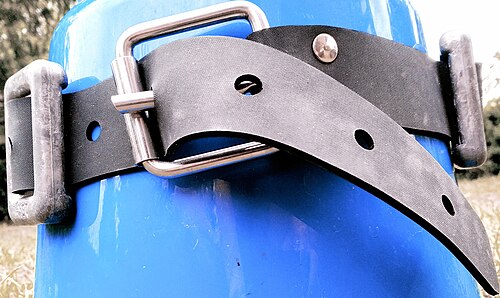
Photo: Monsieur Fou, CC0 1.0, via Wikimedia Commons
Why buoyancy matters more than you think
Spearfishing is not scuba diving. You have no BCD, no tank, and no instructor adjusting your weight at the start of every dive. Your weight belt is your entire buoyancy control system. Get it wrong and everything else suffers: equalising feels harder, bottom time shrinks, shots are rushed, and ascents become a fight when you are tired and hypoxic.
In Victorian waters you are typically diving 3–8 metres on shore reefs — Port Phillip Bay weed edges, Mornington Peninsula drop-offs, Phillip Island gutters. At those depths a 5 mm wetsuit loses a significant chunk of its surface buoyancy as neoprene compresses. Weighting that felt perfect at the car park can leave you clawing for the surface after ninety minutes in the water.
Buoyancy also affects safety directly. An overweighted diver who blacks out near the bottom has to swim harder to reach air. An underweighted diver compensates by exhaling hard to sink — which reduces oxygen reserves before the hunt even starts. The sweet spot is narrow, but it is learnable.
The goal — surface and depth
Two reference points cover most Victorian shore spearfishing.
At the surface: At rest with empty lungs you should float with your eyes at water level. A slow, normal inhale should bring your mouth clear of the water without you having to kick or scull. With full lungs you should float comfortably — not riding so high that waves slap your mask, not so low that you are swallowing water between dives.
At hunting depth: At your typical working depth — often 5–8 metres on Victorian reef — you want neutral or slightly negative buoyancy with a normal breath in your lungs. That lets you lie on the bottom for aspetto without sinking into sand or bouncing off reef. You should not need to fin constantly to stay in position.
If you are fighting to stay down at the surface, you are overweighted. If you cannot reach the bottom without a hard exhale and a kick, you are underweighted. Adjust in small increments and re-test.
Starting point formula
There is no universal formula, but salt-water shore divers often start in this range:
Lead weight (kg) ≈ body weight (kg) × 0.09 to 0.11
Example: an 80 kg diver might begin with 7–9 kg and adjust from there. A 65 kg diver in a 5 mm suit might need 6–7 kg. A larger diver in a 3.5 mm summer suit might need less.
Variables that shift the number:
- Wetsuit thickness — a 5 mm open-cell suit adds far more buoyancy than a 3.5 mm suit. Victorian winter diving often means thicker neoprene and more lead.
- Body composition — higher body fat means more natural buoyancy; lean, muscular divers often need more weight.
- Lung volume — taller divers with larger tidal volume float more.
- Water density — ocean salt water needs more weight than fresh water. Do not copy weight from a pool session for a Bass Strait dive.
- Other gear — a large float, thick gloves, hood, and camera all add buoyancy.
If you are borrowing a suit from the equipment library, treat every loan as a full re-test. A 5 mm suit that fits your mate may be a different thickness and fit on you.
Test procedure — with buddy, shallow water
Never test weight alone. Run this in calm, shallow water (3–5 metres) at a legal dive site with a buddy on the surface.
- Full kit on — suit, fins, mask, snorkel, weight belt, speargun or float line as you will dive. Partial kit gives false results.
- Enter water and settle — let your suit flood and compress for a minute.
- Surface test, empty lungs — exhale fully and hold. You should not sink rapidly to the bottom. A slow descent is acceptable; a plummet means too much weight.
- Surface test, full lungs — inhale fully. You should float with eyes at or near the surface without sculling.
- Depth test — duck dive to 5 metres (or your typical hunting depth). With a normal breath you should hover near neutral. For aspetto, you want to settle on sand or reef without finning.
- Adjust in 0.5–1 kg increments — add or remove lead, re-test each change. Keep a log on your phone.
- End-of-dive re-test — after sixty to ninety minutes, repeat the surface test. A compressed suit and fatigue change how weight feels. Many divers discover they are overweighted by the end of a session.
Do this at the same site you plan to hunt. Bay water, ocean surf, and protected inlet conditions all feel different. Review the safety checklist before every weight test — treat it like a dive day.
Rubber belt rules
Victorian shore spearos overwhelmingly use a rubber weight belt, not a nylon scuba belt. Rubber stretches and stays put around your waist when you breathe and dive.
- Quick-release buckle — must be reachable with either hand, in front or to the side. Practise dumping the belt on the surface until it is muscle memory.
- Weight distribution — thread lead so weights do not slide to one hip. Uneven weight twists your body and makes gun aim inconsistent.
- Belt position — sit it on your hips, not your ribs. A belt that rides up restricts breathing and equalising. If you struggle with Frenzel equalising, check belt position first.
- Ankle weight (advanced) — some divers add a small weight on the gun-side ankle to balance a heavy speargun. This is a fine-tuning step, not a beginner fix for overweighting.
Never use a weight vest as a shortcut for poor belt technique unless you have a specific body type or camera rig that genuinely needs it. Most beginners should master the belt first.
Common mistakes
Copying your mate's weight. Useless. Your bodies, suits, and lung volumes differ. The 9 kg that works for a club veteran might sink a beginner in a borrowed 3.5 mm suit.
Adding weight to sink faster. Tempting when you watch experienced divers drop straight to the bottom. Bad for safety, bad for stealth — crashing into reef spooks everything. Learn to duck dive efficiently instead.
Ignoring wetsuit compression. Five millimetres of neoprene at the surface is not five millimetres at 8 metres. Weight that felt perfect at the start of a dive can leave you heavy at the end.
Overweighting after a new thicker suit. Buying or borrowing a winter suit without re-testing is one of the most common gear mistakes in Victoria. Pair every suit change with a weight test.
Testing in fresh water, diving in salt. Pool or lake tests need less lead than Port Phillip or open coast. Always confirm in the environment you hunt.
Diving overweighted when tired. Late in a session, an overweighted diver is slower to ascend after a long bottom hold. That intersects directly with shallow water blackout risk.
Weighting and safety
If overweighted, a tired diver struggles to ascend — blackout recovery is harder, and your buddy has less time to respond. Err slightly light as a beginner. You can still hunt mid-water, shoot from a slow descent, and build bottom time as technique improves.
Underweighting is safer than overweighting for new divers. You may not hold perfect aspetto on the first session, but you will get to the surface reliably. As your breath-hold and duck dive improve, add small amounts of weight.
Pair correct weighting with non-negotiable habits: one up one down, surface interval at least twice your dive time, no hyperventilation. Read the buddy system guide and blackout awareness article before your first weighted ocean dive.
Victorian conditions — seasonal notes
Summer (3.5 mm suit): Less lead, shallower sessions, more time at the surface between dives. Port Phillip Bay reef edges and Mornington Peninsula shallows are common test sites.
Winter (5 mm+ suit): More lead, colder water, shorter sessions. Re-test when you add a hood or gloves — they add buoyancy.
Murky bay water: You may hunt shallower than open coast. Test at the depth you actually use, not the maximum depth you aspire to.
Borrowed library gear: Different suit thickness, different gun, different float — full re-test every loan. See beginner gear for Victoria for what to bring to your first session.
FAQ
Do I need a weight vest?
Most Victorian shore spearos use a belt only. Vests suit some body types, sidemount camera setups, and divers who cannot get a belt to sit comfortably. Start with a rubber belt and quick-release buckle.
Different weight for pool vs ocean?
Yes — always test in the conditions you dive. Fresh water needs less weight. Salt water, thick wetsuits, and full hunting kit need more. A pool session is useful for equalising practice, not for final weight confirmation.
Borrowed library wetsuit — re-test weight?
Absolutely. Different suit thickness, fit, and compression characteristics change everything. Log your weight per suit and adjust when you swap gear.
How often should I re-check my weight?
After any gear change — new suit, hood, gloves, gun, or float. At least once per season as your fitness and technique change. If you have not dived for months, run a surface test before hunting.
Can I use scuba diving weight pockets?
Not ideal. Spearfishing needs a quick-release belt you can dump instantly. Scuba weight systems are designed for a BCD, not for breath-hold diving and blackout rescue.
What if I cannot reach the bottom at my dive site?
First improve your duck dive and equalising — see can't equalise past 10 metres. If technique is sound, add 0.5 kg and re-test. Do not add 2 kg in one go.