Spearfishing Floats & Dive Flags in Victoria — Visibility and Safety
How to choose a spearfishing float and Alpha dive flag for Victoria — sizes, colours, boat traffic in Port Phillip Bay, and legal visibility requirements.
Boats cannot avoid what they cannot see. In Victoria — particularly Port Phillip Bay, the Mornington Peninsula approaches, and busy ramp areas — a spearfishing float with a clear Alpha flag (blue field with a white swallowtail — the international ICS Alpha signal) is not optional gear. In Victoria, boats must slow to 5 knots within 100 metres of a vessel or buoy showing a dive flag — but only if they can see it.
This guide covers float types, flag standards, sizing for Victorian conditions, and how floats integrate with rigging.
Why floats matter legally and practically
Victoria's rules say divers must tow a buoy with a dive flag (Code Flag A) at least 300 × 200 mm. Breath-hold divers without breathing apparatus are exempt from that rule — but a flag is still the thing that makes boats slow to 5 knots within 100 metres of you, so treat it as mandatory. A boat with divers operating from it must fly its own dive flag (at least 750 × 600 mm on a vessel under 10 m). Search and rescue also locate floats faster than heads in chop.
Practically, your float:
- Holds Alpha flag upright
- Stores catch (where legal)
- Mounts spare line, drink bottle, or PLB on long shore drifts
- Gives buddy a reference when you are on the bottom
Alpha flag — what to use
The international Alpha signal flag indicates restricted manoeuvrability — divers below fit that definition.
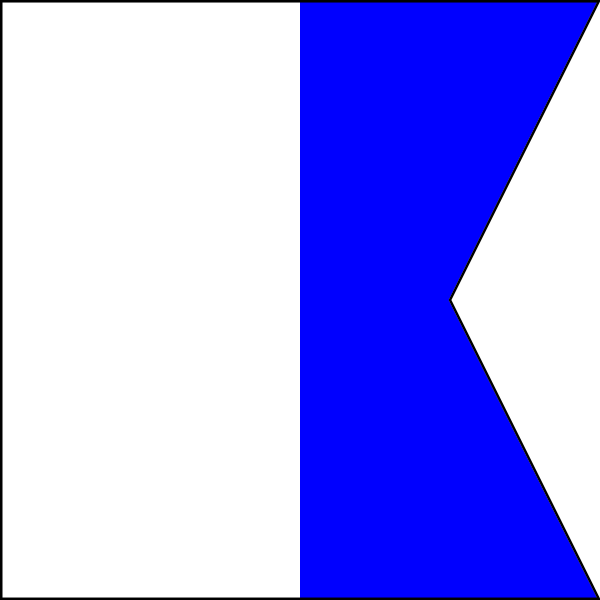
Flag design: Denelson83, public domain, via Wikimedia Commons (International Code of Signals)
Buy:
- Rigid or semi-rigid flag on a short mast — stays visible in wind
- ICS Alpha colours — blue field with white swallowtail (not a generic red/blue dive flag)
- High-contrast, unfaded fabric — sun-bleached flags are worthless
- Tall enough to clear your head when towing — 40–60 cm flag minimum on mast
Avoid:
- Tiny snorkel-only floats with 15 cm flags in Bay traffic
- Flags that collapse in 10 knots of wind
Replace sun-bleached flags yearly if you dive regularly.
Float types
Torpedo / sausage float
Streamlined, low drag. Good for shore entries through surf when sized correctly. Popular Peninsula choice.
Pros: Tows easily; less wind catch than big boards
Cons: Less storage; smaller visual profile — compensate with tall flag
Round / board float
Large visual target. Common on boat dives and when carrying catch bag.
Pros: Very visible; stable platform for gear
Cons: Wind drag on long shore swims
Inflatable vs foam-filled
Foam-filled floats cannot deflate at sea — strongly preferred for serious diving. Inflatables suit travel but carry patch kits.
Sizing for Victorian conditions
| Environment | Float guidance |
|---|---|
| Calm bay, 3–5 m | Medium torpedo + tall Alpha — minimum for Port Phillip |
| Peninsula shore + light wind | Medium-large torpedo or compact board |
| Surf entry | Streamlined torpedo; reinforced attachment points |
| Boat + offshore | Large board float; bright colour (hi-vis orange/yellow common) |
Colour: Hi-vis orange, yellow, or red tops — not camouflage. You want boats to see you.
What to mount on the float
- Alpha flag (mandatory in practice)
- Knife on float — cut line or kelp without reaching to leg
- Catch bag if keeping fish — check bag limits and rules
- PLB or phone in waterproof pouch on long remote drifts (Gippsland, west coast)
- Water bottle on hot summer Peninsula sessions
Avoid clutter that tangles line — every clip is a snag point.
Float with reel vs fixed floatline
Two systems:
- Gun reel + short float bungee to float — you swim with gun; float follows
- Fixed floatline length from gun to float — traditional; length set for depth and kelp
Both need the float on the surface whenever the gun is loaded or fish are attached. See rigging guide.
Boat traffic protocol in Victoria
- Stay within reasonable distance of float — do not leave it on beach while diving 200 m offshore
- Surface near float, not 30 m away in a shipping lane
- Hand signal to boats if they approach — free arm wave
- Never dive under channel markers or ferry lanes in the Bay
Pair with buddy system — surface buddy watches boats while diver is down.
Common mistakes
- Flag at home because "it's calm" — ferries and speedboats do not announce themselves
- Float too small in chop — submerges, invisible
- Catch bag dragging deep — extra drag, pulls float under
- No line between gun and float — lost fish, lost gun, no visibility link
- Camo float — boats need to see you
Maintenance
- Rinse hardware and flag after salt
- Check D-rings and line attachment for UV crack
- Replace worn bungee on float-to-gun connection
- Test PLB battery annually if carried
Library and first purchase
Borrow a float setup with your first speargun loan from the Equipment Library — see what tow drag feels like on a 90-minute Peninsula swim before buying.
FAQ
Is Alpha flag legally required in Victoria?
Not for breath-hold divers towing their own float — the personal flag rule exempts divers without breathing apparatus. A boat with divers operating from it must fly a dive flag. Use one anyway: boats must slow to 5 knots within 100 m of a dive flag.
Can two divers share one float?
Only if both stay under same float's supervision pattern — two separate floats are safer for two active hunters.
Float on belt instead of surface?
Not for primary marking — belt floats do not replace surface Alpha for boat traffic.
What about night spearfishing?
Rare, heavily regulated in practice — lights and extreme visibility required; outside beginner scope.
Best float for Port Phillip Bay beginners?
Medium-large hi-vis torpedo or board with rigid tall Alpha — not minimal snorkel float.
Next read: Float line rigging · Spearfishing spots